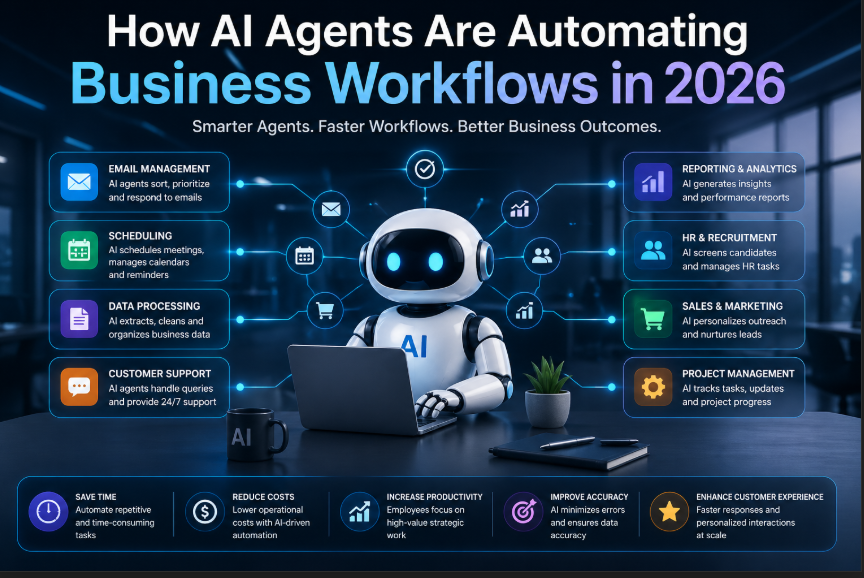
Introduction to AI Agents in Business
Artificial Intelligence has moved far beyond simple automation tools. In 2026, AI agents are becoming a core part of how businesses operate, making workflows faster, smarter, and more efficient. These intelligent systems are capable of handling complex tasks with minimal human involvement, allowing companies to scale operations without increasing workload.
AI agents are not just tools; they are decision-making systems that can analyze data, take actions, and continuously improve performance. As competition increases, businesses are adopting AI agents to stay efficient and competitive in a rapidly evolving digital landscape.
What Are AI Agents
AI agents are software systems designed to perform tasks autonomously. They can observe data, process information, and take actions based on predefined goals or learned behavior. Unlike traditional automation, which follows fixed rules, AI agents can adapt to changing conditions and make intelligent decisions.
These agents are used in various areas such as customer support, marketing, finance, and operations, making them highly versatile in business environments.
How AI Agents Work
AI agents operate by combining data processing, machine learning, and automation. They collect information from different sources, analyze patterns, and execute tasks based on insights. Over time, they learn from past actions and improve their performance.
This ability to learn and adapt makes them more effective than traditional systems, especially in dynamic business environments where conditions change frequently.
Why Businesses Are Adopting AI Agents
Businesses are increasingly adopting AI agents because they offer speed, accuracy, and scalability. They reduce the need for manual work and allow teams to focus on strategic tasks instead of repetitive operations.
In addition, AI agents can operate continuously without fatigue, which improves productivity and ensures consistent performance across workflows.
Evolution of Business Workflows with AI
Business workflows have changed significantly over the years. What was once handled manually is now being automated through intelligent systems powered by AI.
Traditional Manual Workflows
In traditional systems, most business processes were handled manually. Employees were responsible for data entry, communication, and decision-making tasks. This approach was time-consuming and often prone to human error.
Manual workflows also limited scalability, as an increasing workload required hiring more staff and managing larger teams.
Shift Toward Automation
With the introduction of automation tools, businesses started reducing manual effort by using software to handle repetitive tasks. However, these systems were still limited because they followed predefined rules and could not adapt to new situations.
Role of AI in Modern Operations
AI has taken automation to the next level by introducing intelligence into workflows. AI agents can now handle complex tasks, make decisions, and optimize processes in real time. This has transformed business operations, making them more efficient and data-driven.
Key Features of AI Agents
AI agents stand out from traditional tools because of their advanced capabilities. These features allow them to handle complex workflows with minimal human input.
Autonomous Decision-Making
One of the most important features of AI agents is their ability to make decisions independently. They analyze data and choose the best possible action based on predefined goals and learned patterns.
This reduces the need for constant supervision and speeds up business processes.
Continuous Learning and Adaptation
AI agents improve over time by learning from data and past performance. They can adapt to new trends, customer behavior, and business requirements, making them more effective with each interaction.
This continuous learning ensures long-term efficiency and accuracy.
Integration with Business Systems
AI agents can integrate with various business systems such as CRM platforms, marketing tools, and analytics software. This allows them to access data from multiple sources and perform tasks seamlessly across different departments.
AI Agents in Customer Support Automation
Customer support is one of the areas where AI agents have made the biggest impact. Businesses are now using intelligent systems to handle customer interactions more efficiently.
AI Chatbots and Virtual Assistants
AI-powered chatbots and virtual assistants can communicate with customers in real time. They are capable of answering common questions, providing information, and guiding users through processes.
These systems reduce the workload on human support teams and improve response times.
Handling Customer Queries Automatically
AI agents can manage a large number of customer queries simultaneously. They analyze questions, identify intent, and provide accurate responses without human involvement.
This ensures that customers receive quick and consistent support.
Improving Response Time and Satisfaction
Faster responses lead to better customer experiences. AI agents operate 24/7, ensuring that customers can get help at any time. This improves satisfaction and builds trust in the brand.
AI Agents in Marketing and Sales Workflows
Marketing and sales have become highly data-driven, and AI agents are playing a central role in automating these processes. Businesses are now able to attract, engage, and convert customers more efficiently by using intelligent systems that analyze behavior and optimize campaigns in real time.
Lead Generation and Qualification
AI agents can identify potential customers by analyzing online behavior, search patterns, and engagement data. They automatically collect and qualify leads based on predefined criteria, ensuring that sales teams focus only on high-value prospects. This reduces time wasted on unqualified leads and improves overall conversion rates.
Personalized Marketing Campaigns
Personalization is a key factor in modern marketing, and AI agents make it possible at scale. They analyze customer data to create targeted campaigns tailored to individual preferences. This results in more relevant messaging, higher engagement, and better customer experiences.
Sales Funnel Automation
AI agents streamline the entire sales funnel by automating follow-ups, tracking customer interactions, and nurturing leads. They ensure that prospects move smoothly through each stage of the funnel, increasing the chances of successful conversions.
AI Agents in Human Resource Management
Human resource departments are also benefiting from AI-driven automation. AI agents are helping organizations manage recruitment, onboarding, and employee performance more effectively.
Automated Recruitment Processes
AI agents can screen resumes, shortlist candidates, and even conduct initial assessments. This significantly reduces the time required to identify suitable candidates and allows HR teams to focus on final decision-making.
Employee Onboarding Automation
Onboarding new employees involves multiple repetitive tasks such as document verification, training, and system setup. AI agents automate these processes, ensuring a smooth and consistent onboarding experience.
Performance Monitoring and Analytics
AI agents track employee performance by analyzing productivity data and work patterns. They provide insights that help organizations improve efficiency and identify areas where employees may need support or training.
AI Agents for Financial and Accounting Tasks
Finance and accounting require accuracy and consistency, making them ideal areas for AI automation. AI agents help businesses manage financial operations with greater precision and efficiency.
Invoice Processing and Management
AI agents can automatically process invoices by extracting relevant data and updating financial records. This reduces manual data entry and minimizes errors in financial documentation.
Fraud Detection and Risk Analysis
AI systems analyze transaction patterns to identify unusual activities and potential fraud. They can detect risks in real time, helping businesses take preventive action before issues escalate.
Financial Reporting Automation
Generating financial reports can be time-consuming, but AI agents automate this process by collecting and organizing data from multiple sources. This ensures timely and accurate reporting for better decision-making.
AI Agents in Supply Chain and Operations
Supply chain management involves multiple complex processes, and AI agents are helping businesses optimize these operations through automation and data-driven insights.
Inventory Management Automation
AI agents monitor stock levels and predict demand, ensuring that inventory is maintained efficiently. They help prevent overstocking and shortages, which improves overall operational efficiency.
Demand Forecasting with AI
By analyzing historical data and market trends, AI agents can accurately forecast demand. This allows businesses to plan production and distribution more effectively.
Logistics and Delivery Optimization
AI agents optimize delivery routes, manage logistics, and reduce transportation costs. They ensure faster deliveries and improve overall supply chain performance.
Benefits of AI Agents in Business Workflows
AI agents are transforming business operations by improving efficiency, accuracy, and scalability. Companies that adopt these systems are able to streamline processes and gain a competitive advantage in their industry.
Increased Efficiency and Productivity
AI agents handle repetitive and time-consuming tasks much faster than humans. This allows employees to focus on strategic and creative work instead of routine operations. As a result, overall productivity increases and businesses can achieve more in less time.
Cost Reduction and Scalability
By automating workflows, businesses can reduce operational costs associated with manual labor. AI agents also make it easier to scale operations, as they can handle increased workloads without requiring additional human resources.
Improved Accuracy and Decision-Making
AI agents process large amounts of data with high precision, reducing the risk of human error. They also provide data-driven insights that help businesses make informed decisions and improve overall performance.
Challenges of Implementing AI Agents
Despite their advantages, implementing AI agents comes with certain challenges that businesses need to address for successful adoption.
Integration with Existing Systems
Integrating AI agents into existing systems can be complex. Businesses often face compatibility issues and technical difficulties when connecting AI solutions with legacy infrastructure.
Data Privacy and Security Concerns
AI agents rely heavily on data, which raises concerns about privacy and security. Organizations must ensure that they follow proper data protection practices to maintain user trust and comply with regulations.
Initial Setup and Learning Curve
Setting up AI agents requires time, resources, and technical expertise. Teams may need training to understand how to use these systems effectively, which can slow down initial implementation.
Best Practices for Using AI Agents Effectively
To get the most value from AI agents, businesses must follow best practices that ensure efficient and responsible usage.
Choosing the Right AI Tools
Selecting the right tools is essential for success. Businesses should evaluate their needs and choose AI solutions that align with their goals and technical requirements.
Monitoring and Optimizing Performance
AI systems should be continuously monitored and optimized. Regular evaluation helps identify issues, improve performance, and ensure that the system is delivering expected results.
Combining AI with Human Oversight
AI agents should not completely replace human involvement. A balanced approach that combines automation with human judgment leads to better outcomes and reduces the risk of errors.
Future of AI Agents in Business Automation
The role of AI agents in business is expected to grow even further as technology continues to evolve. These systems will become more advanced, intelligent, and integrated into everyday operations.
Emerging Trends in AI Agents
New developments such as autonomous agents, real-time decision systems, and advanced personalization are shaping the future of AI. These innovations will make business workflows even more efficient and adaptive.
Impact on Jobs and Workforce
AI agents will change the nature of work by automating routine tasks. While some roles may decrease, new opportunities will emerge in areas such as AI management, data analysis, and system design.
Long-Term Business Transformation
In the long run, AI agents will redefine how businesses operate. Organizations that adopt these technologies early will be better positioned to innovate, compete, and grow in a digital-first world.
Conclusion
AI agents are no longer a future concept; they are actively transforming business workflows in 2026. From customer support and marketing to finance and operations, these intelligent systems are enabling businesses to operate more efficiently and make smarter decisions.
However, the true value of AI lies in how it is implemented. Businesses that combine AI automation with human expertise will achieve the best results. As technology continues to advance, AI agents will play an even greater role in shaping the future of business.