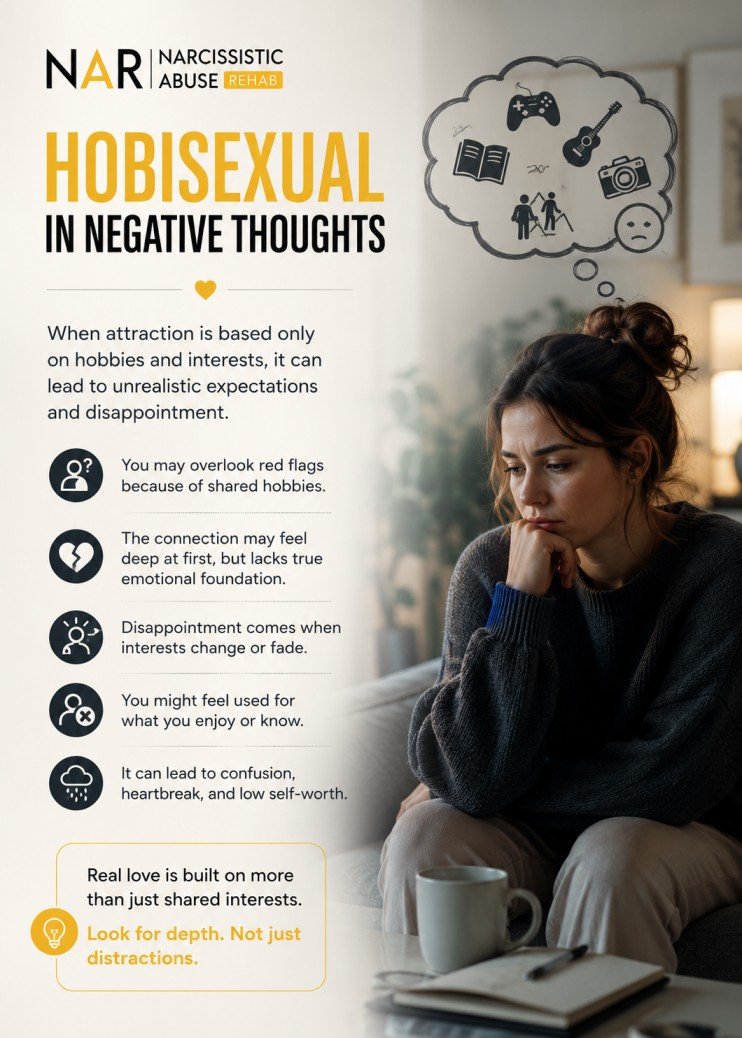
If one is to understand the terrain of contemporary relationships then one must investigate the processes by which people form bonds, why they remain bonded, and what forces produce an emotional and/or practical attachment. Lately, one term that has popped up in online conversations is hobisexual. It is not clinical or academic, but it is becoming more commonplace in social conversations to describe certain patterns in relationships that focus on convenience, housing, or financial stability rather than intimacy.
Narcissistic Abuse Rehab specializes in helping individuals recognize toxic relationship patterns and emotional manipulation and recover from toxic dynamics. Discussing concepts like hobisexual activity can help people identify warning signs earlier and make better choices when it comes to their relationships.
In this article, we will look at what defines a hobisexual, what signs to look for in relationships, the emotional and psychological risks that can arise, and how recovery and healing can occur after experiencing imbalanced or exploitative relationships.
What Is a Hobisexual?
The term “hobisexual“ is a slang expression used to describe someone who enters or maintains a romantic relationship primarily for practical benefits such as housing, financial support, or lifestyle convenience rather than genuine emotional connection.
In short, a hobisexual relationship is often built on need and not on love. There may be an emphasis on stability, resources, or comfort rather than mutual emotional bonding or long-term compatibility.
It is important to underline that the term is informal and not part of any psychological diagnosis. But it does tap into real anxieties people have about relationships where there is an imbalance of investment of feelings or where one partner appears to be getting more materially than emotionally.
At Narcissistic Abuse Rehab, we encourage our readers to focus less on labeling people as narcissists and more on behaviors and patterns that may be a sign of unhealthy relationship dynamics.
Why the Concept of Hobisexuality Became Popular
Dating apps, economic instability, and changing social expectations have made relationships more complicated. “People are more openly talking about financial dependency, living arrangements, and lifestyle compatibility earlier in relationships.
The word “hobisexual” caught on because it names a situation many people have lived through but struggled to put into words: when a partner seems more interested in what they can give you in terms of material things than emotional things.
The term is used in online communities to refer to concerns such as the following:
- Inequality of contribution in relationships
- Dependence on a partner for housing or money
- Absence of emotional reciprocity
- Commitment based on convenience
It is an informal term, but the experiences it refers to can be emotionally meaningful and sometimes damaging.
Common Signs of Hobisexual Behavior in Relationships
Recognizing patterns is more helpful than focusing on labels. Below are some commonly discussed signs associated with hobisexual behavior in relationships.
1. Fast Attachment Based on Stability
A person may quickly become emotionally or romantically involved once they identify financial or housing stability in a partner. The relationship can proceed at an unusually fast pace, particularly if cohabitation occurs early on.
2. Financial Dependence Without Balance
One partner might be very dependent on the other for money, rent, or everyday expenses without contributing anything worthwhile. Short-term support is normal, but long-term imbalance may indicate a dependency-driven dynamic.
3. Emotional Inconstancy
Affection and attention could shift depending on what the partner is getting back. The emotional connection might seem to be conditional instead of consistent.
4. Avoiding Long-Term Commitment
A hobisexual pattern may include things such as not having financial independence, career plans, or long-term personal goals while using the relationship as the main support system.
5. Relationship of convenience
When it offers comfort or security, it might seem most powerful. When those benefits are debated, emotional distance or conflict can rise.
At Narcissistic Abuse Rehab, we want to stress that these signs are not to be used as labels or as shaming tools, but rather as a way to determine whether or not a relationship is balanced and emotionally healthy.
Psychological Impact and Emotional Dangers
Being in a relationship where the emotional investment is uneven can have long-term effects on mental health and self-esteem.
Emotional Fatigue
One partner may feel they are constantly giving—financially, emotionally, or practically—without receiving equal support in return. This can lead to burnout and resentment.
Confusion and Self-Doubt
When affection feels conditional, individuals may question their own worth or judgment, wondering if they are being valued for who they are or what they provide.
Trust Issues
If you’ve had transactional relationships, it can be hard to trust future partners or create secure emotional bonds.
Anxiety & Stress
Emotional imbalance and financial pressure can lead to prolonged stress, especially if one partner feels the weight of stability alone.
At Narcissistic Abuse Rehab, we often see that emotional imbalance in relationships can overlap with patterns of manipulation, dependency, or unhealthy attachment styles.
Is Hobisexual Behavior Always Intentional?
Not always. It is important to approach this topic with nuance.
Not all people are looking for a relationship for material gain. Instead, they might be struggling with intentionally seeking out relationships for material benefit. Instead, they may be dealing with:
- Financial difficulty
- Absence of independence
- Emotional immaturity
- Unstable life circumstances
- Dependency patterns learned
But even without ill will, a relationship can become unhealthy if there is an imbalance, a lack of accountability, or emotional reciprocity between partners.
It is important to understand intent vs. impact to evaluate the health of a relationship.
Relation to Narcissistic Abuse and Toxic Dynamics
While hobisexual behavior is not the same as narcissistic abuse, there can be overlapping dynamics in some cases.
For example, a relationship could be made up of:
- One partner exploiting emotional or financial support
- Lack of empathy or mutual care
- One-sided dependency
- Manipulative behaviors to maintain comfort or resources
At Narcissistic Abuse Rehab, we help individuals recognize when relationships move from being simply imbalanced to emotionally harmful or manipulative.
Understanding these patterns can empower individuals to set boundaries and protect their emotional well-being.
Recovery After a Hobisexual or Imbalanced Relationship
Healing after any emotionally draining relationship takes time and self-awareness. Recovery is not about blame—it is about rebuilding emotional strength and clarity.
1. Understand the experience
Recognizing that the relationship felt out of balance is the first step in healing.
2. Restore Boundaries
Building personal stability reduces vulnerability to future imbalanced relationships. of recovery is learning to say no.
3. Enhance financial and emotional autonomy
Building personal stability helps reduce vulnerability to future imbalanced relationships.
4. Look at Relationship Patterns
What kept you in the relationship? Looking at this can help you avoid repeating similar patterns in the future.
5. Seek Support
Talking to trusted friends, support communities, or professionals can help put things into perspective.
Narcissistic Abuse Rehab promotes a view of recovery as a process of empowerment, not loss.
Constructing Healthier Relationships for the Future
Healthy relationships are based on emotional connection and mutual effort. Key signs of a healthy relationship include:
- Mutual respect and care
- Emotional consistency
- Shared responsibility
- Honest communication
- Financial independence, or equity
- Trust and Responsibility
Providing emotional and practical support to each other increases the chances of a stable and satisfying relationship.
Summary Conclusion
Hobisexuality is a concept that can lead to some valuable discussions about what drives a relationship, emotional balance, and individual limits. It’s not a clinical term, but it does describe real experiences that many people have in modern dating and relationships.
Recognizing these patterns can help people identify red flags early, avoid emotional burnout, and make healthier decisions.
The mission of Narcissistic Abuse Rehab is to educate, support, and guide people through the understanding of toxic relationship dynamics and rebuilding their emotional strength. What matters most is emotional safety, mutual respect, and authentic connection, regardless of the label.
“Awareness is the first step towards healthier relationships and stronger self-worth.” Healing is possible.