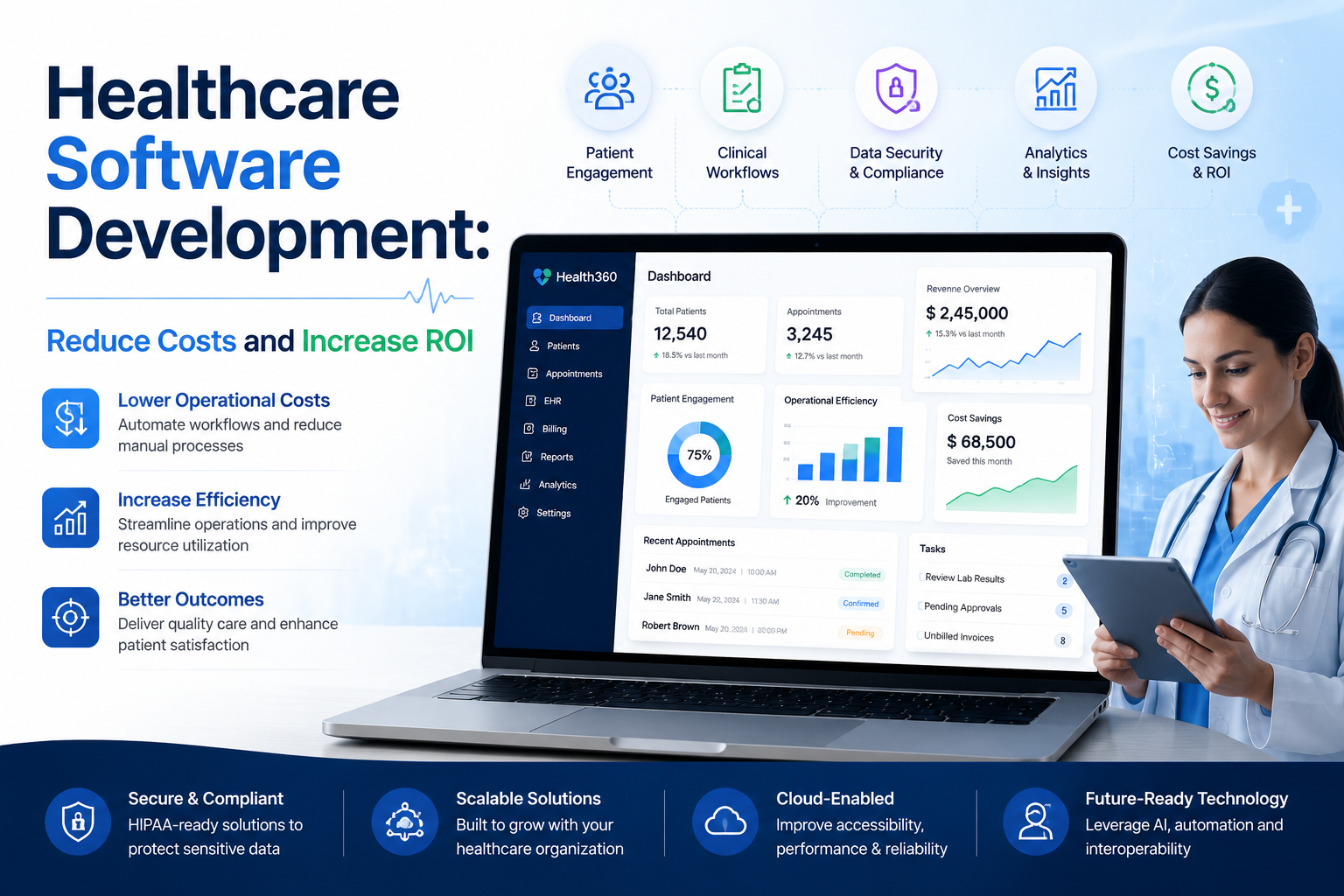
Ask anyone who runs a hospital or a mid-size clinic what they worry about most, and money will be mentioned within the first two minutes. Staffing costs are fast, and legacy systems eat up hours staff doesn’t have. That’s precisely where healthcare software development enters the picture, and it’s changing the game for organizations that once believed custom tech was exclusively for large hospital networks.
Healthcare software development is not simply replacing paper charts with a screen. When built with the right priorities, it touches scheduling, billing, patient records, and even clinical workflows simultaneously. “Savings often come in sooner than the budget forecasts suggest, and that’s a big reason more clinics are paying attention now.
The Cost Problem Healthcare Software Development Is Built to Fix
Most health care organizations don’t lose money in one obvious place. It leaks out slowly, through things like duplicate lab orders because the two systems don’t talk to each other, front desk staff spending 20 minutes on a form that should take 2, and insurance claims bouncing back because a field was filled out incorrectly. None of it is dramatic on its own. Add it up over a year, though, and you’re looking at real losses.
That’s often when a practice starts to look into Healthcare Software Development Services, usually after realizing that patching an old system costs more than replacing it. Legacy platforms are prone to constant workarounds. And every workaround is another hour someone’s paying for.
Healthcare Technology Solutions Are Finally Catching Up
The situation at hospitals used to be that the software had no provisions for compatibility with any other systems. Not anymore. New platforms have been designed with interoperability in mind; therefore, all that you need will be able to exchange information, rather than having someone retype it into the database.
The use of cloud-based architecture cannot be underestimated either. There will be no need to buy expensive servers or employ a specialist in order to take care of them. Expansion in response to the seasonal peak of patients is no longer an issue.
Telehealth Changed What Patients Expect
Not long ago, virtual consultations were considered a luxury. Nowadays, people expect them even before scheduling their appointments. The development of telemedicine solutions was one means for small practices to deal with large ones without needing an additional building. Fewer no-shows, reduced cost per visit, and no need for people to miss half of their workday for an appointment.
This is not only because telemedicine is effective at improving people’s experiences. The economic aspect of adopting telemedicine solutions is supported by a 2023 World Bank study, which states that properly implemented digital health interventions can reduce health system costs for governments by up to 15%. It is a lot of money, given the limited budgets governments work with, prompting them to reconsider their IT infrastructure.
AI Is Doing the boring work, so staff don’t Have To
This is likely the area that gets the most attention, and rightly so. AI in healthcare software development does seem scary when you first hear the term until you realize exactly what it’s doing on a daily basis. The technology is taking care of clerical tasks such as pre-sorting claims before they are reviewed by a person, identifying scheduling conflicts, and spotting documentation issues before they result in rejected claims.
Prior authorizations are a great example. They used to take several days and many phone calls. Now, with the proper AI-supported workflow, most of it can be done in a matter of hours. Do the math for several hundred patients a month – it adds up fast.
Another aspect worthy of discussion, though less covered than claims processing, is the field of diagnostic support. AI-powered image review does not substitute radiologists; however, it prioritizes those images that require additional attention from the physician, which is crucial in situations where the department has been in backlog for several days. There are cases where predictive analytics of patient admission risk is used alongside AI-powered image review, enabling timely detection of issues and preventing an extremely costly procedure. All the above cannot be seen as a significant saving on a spreadsheet, yet all the benefits combined result in lower costs per patient throughout the year.
Without this sort of talent in your own ranks, it’s not uncommon to go out and look for AI Developers to bring into the practice, rather than train this capability up from scratch. It’s easier, and frankly, less dangerous, since you’re dealing with skills HR isn’t used to recruiting for.
Another factor worth considering is diagnostic support, which tends to be somewhat overlooked compared to claims processing. Automated image reading via artificial intelligence does not replace a radiologist, but the technology helps identify images that require extra scrutiny first, which is particularly important when the department has a queue of several days. The approach is sometimes coupled with predictive analytics for readmissions to identify problems before the need for more costly procedures arises. None of the above measures produces a single spectacular result on the balance sheet, but together they help to reduce the costs per patient.
If your team doesn’t have this kind of talent in-house, many practices choose to hire AI Developers rather than build that expertise from scratch. It’s usually faster and, honestly, less risky than hiring blind for a skill set most HR teams aren’t yet familiar with.
Automation Is Where the Real ROI Shows Up
People tend to underestimate automation because it’s not flashy. But this is where a lot of the actual return on investment happens, quietly, in the background.
A some places automation tends to pay for itself fast:
- Follow-up messages for appointments are sent automatically without having to make any manual phone call.
- Claims scrubbing, which detects errors prior to submission and in case of rejection.
- Inventory and supply tracking that flags low stock before it becomes a problem.
- Compliance reporting, which used to take a full day, is now running in the background.
- Patient intake forms that sync straight into the record instead of getting re-typed
None of these individually feels like a big deal. Together, they free up staff hours that used to be lost to repetitive tasks. That’s usually when practices start looking serioudly at healthcare automation solutions, not because it sounds impressive, but because someone finally did the math on how many hours were being wasted every week.
Finding the Right Healthcare Software Solutions for Your Budget
Not every clinic needs the same setup and that’s worth saying plainly. A five-provider practice doesn’t need what a regional hospital network needs and trying to buy the same tier of software can waste money just as easily as sticking with outdated tools.
A few things worth keeping in mind before signing with any vendor:
- Find out what will happen to your data if you change vendors in the future.
- Get HIPAA-compliant status in writing, not just in the sales talk.
- Find a couple of weak areas initially rather than changing the entire system.
- Be patient, wait for at least one year before seeing the results.
It also helps to ask a potential development partner for examples of past healthcare projects, not just a generic portfolio. Compliance experience matters more in this industry than in most others, and a team that’s already handled HIPAA audits or state-level privacy rules will save you time you didn’t know you needed. The initial estimated rate rarely tells the whole story, so it’s worth asking about maintenance costs and support response times before anything is signed.
While healthcare software development cannot be seen as some kind of magic that saves money instantly, whoever claims that should be viewed with caution. When this process is done correctly, however, with a proper partner and understanding of what expenses you are trying to save on, your financial results will speak for themselves within the next year or two.