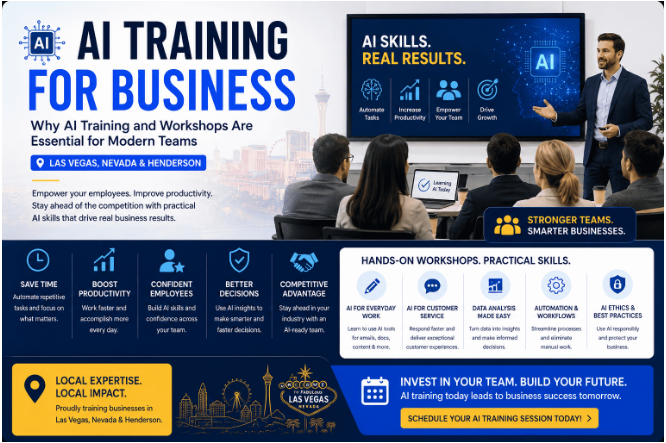
Every business owner in Las Vegas is hearing the same message: AI is changing the way companies work. But here’s what many people are missing.
Buying an AI tool isn’t what creates a competitive advantage. Knowing how to use it does.
Across Las Vegas, businesses are discovering that artificial intelligence delivers the best results when employees understand how to apply it to their daily work. From hotels on the Strip and real estate agencies to law firms, healthcare practices, contractors, and local retailers, organizations are investing in AI Training for Business to help their teams work smarter, respond faster, and stay ahead of the competition.
The shift isn’t happening because AI is trendy. It’s happening because the numbers make business sense.
According to recent workplace research, nearly eight out of ten organizations worldwide now use AI in at least one business function, and the adoption rate continues to climb each year. At the same time, studies show that generative AI has the potential to contribute trillions of dollars to the global economy annually by improving productivity and automating repetitive work.
For business owners, those numbers translate into a simple question:
Is your team ready to use AI effectively, or are they still figuring it out on their own?
That’s why AI Training and Workshops have become one of the smartest investments businesses can make in 2026.
Las Vegas Has Always Been Built on Innovation
Las Vegas has never been a city that waits for change.
From world-class hospitality and entertainment to healthcare, finance, logistics, and professional services, businesses here compete in one of the fastest-moving markets in the country.
Customers expect immediate answers.
Employees need better tools.
Competition grows every year.
Artificial intelligence is helping businesses meet those expectations, but only when employees know how to use it properly.
Think about a typical workday.
Your sales team writes dozens of emails.
Customer service responds to repetitive questions.
Marketing creates social media posts, blogs, and ad copy.
Managers summarize meetings and prepare reports.
Human resources screens resumes and drafts job descriptions.
Now imagine reducing the time spent on each of those tasks without lowering quality.
That is exactly why businesses are prioritizing AI employee training instead of simply purchasing another software subscription.
AI Doesn’t Replace Great Employees. It Makes Them More Productive.
One of the biggest misconceptions about artificial intelligence is that it replaces people.
In reality, successful businesses use AI to eliminate repetitive work so employees can focus on higher-value responsibilities.
A customer service representative spends less time searching for answers and more time solving customer problems.
A salesperson spends less time writing follow-up emails and more time building relationships.
A marketing manager creates campaign ideas in minutes instead of hours.
An office administrator automates documentation and scheduling rather than handling everything manually.
When employees understand how to use AI correctly, they become more productive without sacrificing creativity or critical thinking.
That is why AI team training has become a strategic priority for companies that want to improve efficiency while supporting their workforce.
The Cost of Waiting Is Higher Than Many Business Owners Realize
Many companies assume they can introduce AI later.
Unfortunately, waiting often creates bigger challenges.
Employees begin using public AI tools without guidance.
Different departments develop inconsistent workflows.
Sensitive information may be shared without proper policies.
Teams become frustrated because they aren’t seeing meaningful results.
Eventually, businesses conclude that AI “doesn’t work,” when the real issue is a lack of training.
The organizations seeing the greatest return on investment aren’t necessarily using more AI tools. They’re helping employees understand how to use the tools they already have.
That’s the difference between experimenting with AI and building an AI-ready business.
Why AI Training Delivers Better ROI Than Buying Another Software Subscription
Every year, businesses invest thousands of dollars in new software hoping it will solve productivity challenges. Yet many of those tools end up underused because employees never receive proper training.
Artificial intelligence is no different.
An AI platform is only as valuable as the people using it. Without clear guidance, employees often use AI inconsistently or avoid it altogether because they aren’t confident in the results.
AI Training for Business changes that. Instead of teaching employees which buttons to click, it teaches them how to think about AI as a daily productivity partner.
Employees learn when AI should be used, when human judgment matters most, and how to create better outcomes using both.
For example, a sales representative can draft personalized follow-up emails in minutes, while a marketing team can brainstorm campaign ideas, summarize market research, and create first drafts of content much faster. Finance teams can organize reports, HR professionals can streamline hiring communication, and operations managers can document processes more efficiently.
The result isn’t simply faster work. It’s smarter work.
Five Business Departments That Benefit First
Almost every department can benefit from AI, but some teams see results almost immediately after training.
Sales
Sales professionals spend a large portion of their week on administrative work instead of selling. AI helps them write proposals, summarize client meetings, prepare follow-up emails, and research prospects more efficiently.
With proper AI team training, sales representatives spend more time building relationships and closing deals.
Customer Service
Customers expect fast responses regardless of the time of day.
AI helps support teams draft replies, summarize conversations, organize knowledge bases, and respond consistently. Human representatives remain in control while AI reduces repetitive tasks.
This leads to faster response times and higher customer satisfaction.
Marketing
Marketing departments often work under tight deadlines.
AI assists with:
- Blog outlines
- Social media content
- Email campaigns
- Keyword research
- Advertising ideas
- Content repurposing
- Video scripts
Instead of replacing creativity, AI gives marketers a faster starting point.
Human Resources
Hiring, onboarding, and employee communication require significant administrative work.
AI helps HR teams draft job descriptions, organize interview notes, summarize resumes, create onboarding materials, and answer frequently asked employee questions.
This allows HR professionals to spend more time focusing on people rather than paperwork.
Operations and Administration
Operations teams are responsible for keeping businesses running efficiently.
AI supports process documentation, meeting summaries, internal communication, project planning, and workflow improvements.
Even saving thirty minutes per employee each day can translate into hundreds of additional productive hours every month.
What Employees Actually Learn During AI Training
One of the biggest misconceptions is that AI training is technical.
It isn’t.
Modern AI Training and Workshops focus on practical workplace skills that employees can apply immediately.
Topics often include:
- Writing effective AI prompts
- Creating professional emails
- Summarizing meetings and documents
- Automating repetitive office tasks
- Researching information more efficiently
- Creating presentations and reports
- Improving customer communication
- Using AI responsibly and securely
- Protecting confidential business information
Hands-on practice is what makes the biggest difference. Employees leave with real workflows they can use the very next day instead of theoretical knowledge they’ll quickly forget.
How Businesses Across Las Vegas Are Using AI
The demand for AI agents is growing across nearly every industry in Las Vegas.
Hotels are improving guest communication.
Real estate agencies are creating listing descriptions and responding to inquiries faster.
Healthcare providers are reducing administrative workloads.
Law firms are organizing documentation more efficiently.
Construction companies are improving project communication.
Marketing agencies are delivering campaigns faster while serving more clients.
These businesses aren’t replacing their employees. They’re giving them better tools to succeed.
AI Adoption Is Growing Across Henderson and Nevada
The momentum extends beyond Las Vegas. Businesses throughout Henderson and across Nevada are investing in workforce development as AI becomes part of everyday operations.
Small businesses are using AI to compete with larger organizations by automating routine tasks without expanding payroll. Larger companies are using AI to improve collaboration, strengthen customer service, and make faster business decisions.
Regardless of company size, one trend remains consistent. Organizations that combine AI technology with employee education achieve stronger results than those relying on software alone.
That is why AI employee training has become an important part of long-term business planning rather than a short-term technology project.
What Makes an Effective AI Training Program?
Not all AI training programs deliver the same results. Watching online videos or attending a one-time webinar may introduce employees to AI, but it rarely changes how they work.
An effective AI Training for Business program is practical, interactive, and tailored to the organization’s goals. Employees should leave each session with skills they can apply immediately, whether that’s writing better prompts, automating repetitive tasks, improving customer communication, or using AI responsibly.
The best workshops also include real business scenarios instead of generic demonstrations. When employees see how AI fits into their daily responsibilities, adoption happens faster and confidence grows naturally.
Successful training programs typically include:
- Hands-on exercises using real business tasks
- Department-specific AI workflows
- AI best practices and prompt writing
- Data privacy and security guidelines
- Responsible AI usage
- Ongoing support and continuous learning
This approach helps businesses turn AI from an interesting tool into a measurable business advantage.
Why Local Businesses Choose Cevra AI
Every business has unique goals, challenges, and workflows. A generic AI course may explain the technology, but it often fails to address how AI fits into a specific organization.
That’s where Cevra AI makes a difference.
Instead of offering one-size-fits-all training, Cevra AI works with businesses to create customized AI Training and Workshops that align with real business objectives.
Whether you’re leading a growing startup in Henderson, managing a professional services firm in Las Vegas, or expanding operations across Nevada, training can be tailored to your industry, department, and business priorities.
Programs can cover:
- AI productivity tools
- AI-powered business communication
- Sales and marketing automation
- Customer service workflows
- Executive AI strategy
- Responsible AI implementation
- Department-specific AI use cases
The goal isn’t simply to introduce AI. It’s to help teams become more productive, more confident, and better prepared for the future of work.
Frequently Asked Questions
What is AI Training for Business?
AI Training for Business helps organizations teach employees how to use artificial intelligence to improve productivity, automate repetitive tasks, enhance collaboration, and make smarter business decisions.
Why is AI employee training important?
AI tools deliver the best results when employees understand how to use them effectively. Proper training improves adoption, reduces errors, increases productivity, and helps businesses achieve a better return on their AI investments.
What happens during AI Training and Workshops?
Most workshops include hands-on exercises, AI prompt writing, workflow automation, responsible AI practices, productivity techniques, and real-world business examples that employees can apply immediately.
Which industries benefit from AI team training?
Hospitality, healthcare, legal services, construction, finance, real estate, retail, education, manufacturing, and professional services can all benefit from AI team training. Any organization that relies on communication, data, or repetitive processes can improve efficiency with AI.
Is AI training only for large companies?
No. Small and medium-sized businesses often see significant benefits because AI helps them accomplish more with existing resources. Even a small team can improve efficiency, customer service, and decision-making through practical AI training.
The Future Belongs to Businesses That Invest in Their People
Artificial intelligence is changing how businesses operate, but technology alone doesn’t create success. The organizations gaining a competitive advantage are the ones investing in their people first.
Employees who understand AI are more confident, more productive, and better equipped to solve problems. They communicate more effectively, complete repetitive work faster, and spend more time focusing on customers, innovation, and business growth.
For businesses across Las Vegas, Henderson, and Nevada, AI training is quickly becoming as essential as leadership development or technical skills training. Companies that start building AI capabilities today will be better positioned to adapt as technology continues to evolve.
Whether you’re looking to improve sales, streamline operations, strengthen customer service, or help employees work more efficiently, AI Training Tools for Business provides a practical path forward.
The question is no longer whether AI will shape the future of business. It already is. The real question is whether your team will be ready to lead that future or spend valuable time trying to catch up.
By investing in AI team training and AI employee training today, your organization can build a more agile workforce, create lasting operational improvements, and stay competitive in one of the country’s fastest-moving business environments.
The businesses that thrive over the next decade won’t simply have access to AI. They’ll have teams that know how to use it with confidence, responsibility, and purpose.